


-

Naveen Mp
- 2025/11/07
The End of Dispatch Chaos: How Agentic AI is Revolutionizing Field Service Management
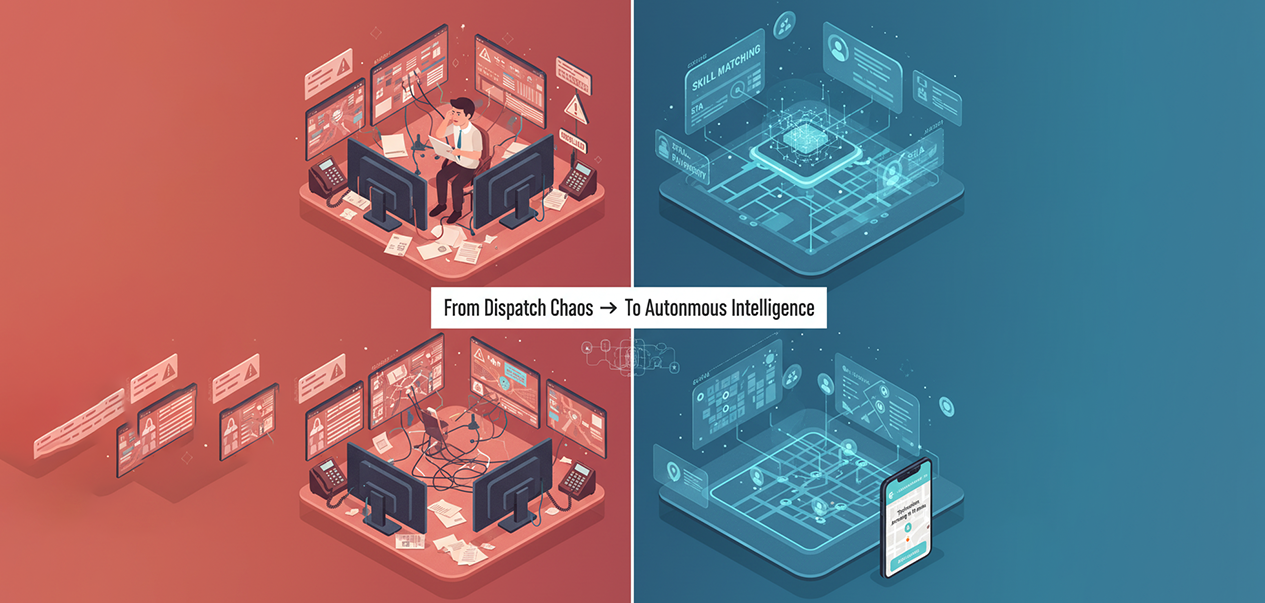
The traditional Field Service Management (FSM) model is broken. It’s defined by manual oversight, reactive scheduling, and the painful delay between equipment failure and technician arrival. Service managers are forced to juggle countless real-time variables—Who's free? Who has the right skills? Where are they right now?—leading to wasted time, high costs, and frustrated customers.
But a new, intelligent approach is emerging. By deploying Agentic AI, FSM is shifting from a complex logistical puzzle to a self-driving system. Welcome to the future of service, powered by platforms like IntelliServe.
🤯 Introducing the Autonomous Dispatcher
Agentic AI refers to systems that can perceive their environment, act autonomously to achieve goals, and learn over time. In the context of FSM, the goal is simple: to assign the absolute best technician to the job, instantly and automatically.
This means eliminating the dispatcher and letting the intelligence run the show. When a service request comes in, the Agentic AI engine processes a matrix of variables that no human can manage simultaneously:
1. Pinpoint Skill and Certification Matching
The AI ensures that the required expertise is the first priority. It verifies the technician’s detailed profile—including specific certifications, experience level, and nuanced skill sets—against the requirements of the faulty equipment. This instantly improves the First-Time Fix Rate, saving the cost of a return trip.
2. Hyper-Optimized Proximity and Schedule
The system doesn't just look for who is "closest." It integrates real-time technician GPS data with the job site's exact Lat/Long coordinates to calculate the fastest ETA, not just the shortest distance. Simultaneously, it confirms the technician's availability and current schedule—they won't be assigned a job outside their shift or while committed to a higher-priority task.
3. Priority and SLA Adherence
Critical issues demand immediate attention. The Agentic AI is programmed to weigh the Issue Priority heavily. For high-priority service requests, the AI may override proximity to choose a slightly further technician if they are the only one available to meet a tight Service Level Agreement (SLA).
By combining these factors into a powerful, weighted score, the AI generates a ranked list of candidates. The job is immediately offered to the top technician. If they decline (or fail to respond within a time limit), the request automatically cascades to the next best match, ensuring zero manual delay.
📈 Beyond Dispatch: Intelligence Across the Service Lifecycle
The power of AI extends far beyond the moment of assignment, redefining every stage of service delivery:
1. Customer Self-Service and Prevention
Before the AI dispatches anyone, the system aims for self-resolution. Using a Large Language Model (LLM) trained on historical service data, the application provides the customer with instant troubleshooting suggestions based on the reported fault. This diverts simple issues and saves expensive truck rolls.
2. The Customer Experience Revolution
Once a service request is confirmed, the frustration of waiting vanishes. The customer receives proactive push notifications for every critical status change. Crucially, the customer app enables live, Uber-style tracking of the technician on a map. If the technician is delayed, the system's dynamic ETA calculation automatically triggers an alert to the customer with the new expected arrival time—transparency that builds trust.
3. Data-Driven Insights
By automating and tracking every step, the system generates clean, reliable data. This allows Org Admins to access crucial metrics like Average Time to Resolution (ATT), technician productivity rankings, and First-Time Fix Rates via an administrative dashboard. This insight turns raw service data into actionable business intelligence.
The Future of FSM is Now
Agentic AI transforms Field Service Management from a reactive, manual operation into a proactive, intelligent workflow. By optimizing every single assignment, reducing response times, and providing unprecedented customer transparency, companies can expect a significant reduction in operational costs and a corresponding leap in customer satisfaction.
The question is no longer if AI will manage your field service— it's when you'll integrate this autonomous intelligence to leave dispatch chaos behind.
The question is no longer if AI will manage your field service — it’s when you’ll integrate this autonomous intelligence to leave dispatch chaos behind. - Naveen Mp, Principal Engineer